Choosing a pipe material is usually presented as a technical decision. But two houses on the same street can have different answers. That is why “what is the best pipe?” has no useful answer on its own. Copper, PEX, PVC, HDPE and vitrified clay are each correct in the right application and each wrong in the wrong one. A plumber in Melton can help determine which material works best for the property and intended use.
Start With What the Pipe Has To Do
Before comparing materials, answer four questions. Each one narrows the field quickly, and getting them wrong costs more than any choice between brands.
What is it carrying?
Drinking water, heated water, gas, sewage, stormwater and irrigation each impose different requirements, and approval for one does not imply approval for another. A pipe approved for cold potable water is not automatically approved for gas, and a drainage product is never acceptable on a drinking water line. This sounds obvious, yet plenty of failed DIY work comes down to exactly this substitution.
What pressure and temperature will it see?
Mains pressure plus stored hot water at 60°C or more is a far harsher duty than cold water at the same pressure. Temperature is the constraint that eliminates options fastest. PVC-U is a good drainage material and a poor choice for heated water, because it softens well below the temperatures a hot line reaches. PEX and copper are both engineered for heat, but with different limits on pressure and temperature rating that need to be checked against the manufacturer’s table rather than assumed.
Where is it going?
Buried in clay, cast into a slab, run through a wall cavity, exposed on a fence line and sitting in a hot ceiling space are five different environments. Some materials need protection from sunlight, some need continuous support, and some cannot be encased in concrete without sleeving. Where the pipe runs usually decides the joining method as much as the material itself.
The Materials You Will Be Offered
These are the materials a Victorian plumber is realistically quoting on. Each has a legitimate place, which is worth remembering when a quote comes in using only one of them for every application.
Copper
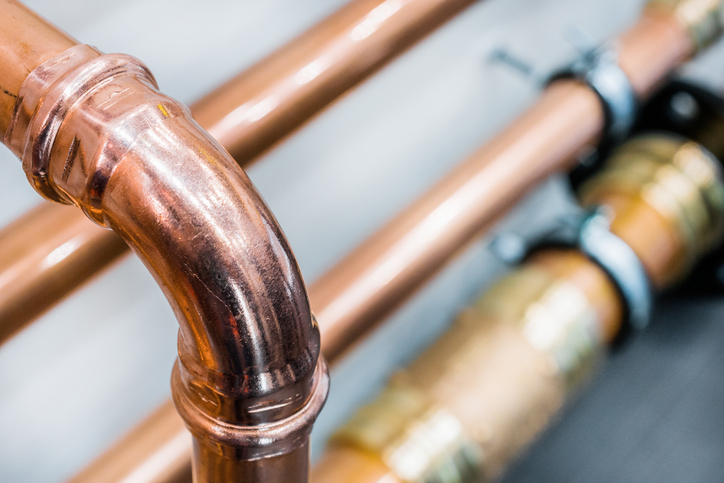
Copper tube for plumbing, gasfitting and drainage is covered by AS 1432, and the wall thickness you get matters as much as the material. It handles hot water and gas comfortably, takes high temperature without complaint, and is genuinely long lived. It is also rigid, which is both a strength and a weakness, and it is the most expensive of the common options. Joints are soldered, brazed or made with press fittings.
- Best suited to hot water lines, exposed runs where neatness matters, and gas
- Long service life, well understood by every plumber in the trade
- Can suffer pinhole corrosion where water chemistry is aggressive
- Transmits noise and does not absorb building movement
Cross-linked polyethylene (PEX)
PEX is made to AS/NZS 2492 and installed as a system under AS/NZS 2537. It arrives in coils, bends around corners, and can be run in long continuous lengths, which is why it has largely taken over domestic water reticulation. It also copes with minor movement, which matters on reactive clay. The weaknesses are real though: it is not UV stable, it needs protection where it passes through slabs or tight framing, and the fittings rather than the pipe are usually where problems appear.
Unplasticised PVC (PVC-U)
PVC-U is the standard material for drainage. Drain waste and vent pipe is covered by AS/NZS 1260, and stormwater pipe by AS/NZS 1254. It is cheap, smooth, chemically resistant and quick to install with solvent cement joints. It is also rigid and brittle under impact, particularly in cold weather, and it has no place on a hot water line. Joints depend entirely on good preparation, which is where most PVC leaks begin.
High density polyethylene (HDPE)
HDPE pressure pipe is made to AS/NZS 4130 and installed under AS/NZS 2033. It is tough, flexible, resistant to most chemicals, and joined by fusion welding rather than glue, which produces a joint as strong as the pipe itself. That combination makes it the material of choice for buried water mains, sewer rising mains and long underground runs where excavation and repair would be costly. It needs the right fusion equipment and operator skill, so it is not a material to improvise with.
Multilayer composite
A multilayer pipe sandwiches an aluminium core between layers of polyethylene. It bends and then holds the shape it is bent into, which suits exposed hot water runs and heating circuits where neat right angles matter. It has less thermal expansion than plain PEX and holds pressure well. Fewer installers use it day to day than PEX or copper, so it pays to confirm experience before specifying it.
Vitrified clay
Clay sewer pipe, made to AS 1741, is chemically inert and effectively immune to the sulphuric acid attack that eventually damages concrete and cast iron. That is why so much of it is still in the ground and still functioning after fifty years. Its weakness is physical: it is rigid and brittle, it needs proper bedding, and every joint is an invitation for roots.
Galvanised steel and cast iron
These are legacy materials rather than options. Galvanised steel water lines corrode from the inside out and restrict flow long before they fail completely. Cast iron waste lines rust and tuberculate, narrowing the bore and roughening the wall. If a renovation quote proposes extending either, the better question is whether the existing section should come out at the same time.
Polybutylene
Polybutylene was widely installed in the 1980s and 1990s and later became the subject of major failure claims, which is why it is no longer a material anyone should be specifying. If it is already in your walls, it is worth knowing where it is and planning for replacement rather than waiting for a burst pipe in Melton.
Certification And The Rules
Compliance is not paperwork for its own sake. It is the mechanism that stops an unrated product being buried where nobody will see it again.
WaterMark certification
Plumbing and drainage products sold in Australia are required to carry WaterMark certification, which confirms the product has been tested to the relevant standard. If a product does not carry it, it should not be installed on a regulated plumbing system, no matter how cheap it was or how convincing the packaging looks.
AS/NZS 3500 and the 2025 editions
The AS/NZS 3500 series is the deemed to satisfy pathway called up by the Plumbing Code of Australia. Part 1 covers water services, Part 2 sanitary plumbing and drainage, Part 3 stormwater, Part 4 heated water, and Part 5 domestic installations. The 2025 editions replaced the 2021 versions and apply to plumbing work from 20 October 2025 in Victoria. In practical terms, that means pipe sizing, minimum gradients and acceptable materials are being assessed against a newer document than many older installations were built to.
Licensed work and compliance certificates
Plumbing work in Victoria must be carried out by a licensed plumber, and regulated work requires a compliance certificate. That matters to a homeowner in two ways. It gives you recourse if something fails, and it matters at sale, because unapproved work shows up in a building inspection and can hold up a contract.
The Mistakes That Cost the Most
Almost every expensive pipe failure we are called to involves one of a short list of decisions made early and cheaply.
- Choosing on price per metre rather than on total installed cost, which includes joints, fittings and labour
- Joining dissimilar metals without a dielectric fitting, which accelerates corrosion at the connection
- Burying joints in positions that cannot be accessed later
- Insufficient bedding and cover, which is the most common cause of buried line failure on reactive clay
- Laying drainage flatter than the standard allows, so the line never self-cleanses
- Using a drainage material on a heated line because it looked similar
- Running PEX unprotected through a slab edge or tight framing, where abrasion eventually wins
- Extending old galvanised or polybutylene rather than replacing the section
Frequently Asked Questions
Is PEX as good as copper?
For most domestic cold and heated water applications, yes, provided it is a certified product installed as a complete system. PEX has fewer joints, handles movement better and costs less to install. Copper still has the edge for exposed work, for very high temperature situations, and where a lifetime measured in many decades is the priority. The honest answer is that installation quality matters more than the choice between them.
What pipe should I use for hot water?
Copper is the traditional answer, and a hot water rated PEX or multilayer system is now widely used and entirely legitimate when the manufacturer’s temperature and pressure ratings are respected. What is not acceptable is standard PVC-U, which softens at temperatures a hot water line will reach. Any material on a heated water line also needs to be rated for continuous operation at the stored temperature, not just for a brief peak.
How long do plumbing pipes last?
Copper and HDPE routinely give several decades. PVC drainage does too, provided it is not exposed to impact or ultraviolet light. Galvanised steel and cast iron have the shortest practical life in this application, because they corrode internally and restrict flow long before they leak. Clay sewers can last a very long time structurally, but their joints are the weak point and roots usually get in well before the pipe itself fails.
My house has galvanised pipes. Do they all need replacing?
Not necessarily all at once. Galvanised lines often fail progressively, starting with the runs that carry hot water or sit in the worst soil conditions. A sensible approach is to inspect, identify which sections are already restricted, and replace those while planning for the rest. Extending a failing galvanised line is the one option that reliably disappoints, because the new section simply inherits the old line’s problems.
Conclusion
The right pipe material is the one that suits what it carries and the temperature it sees. If you are building, renovating, or replacing a failed section and want the material choice explained properly rather than assumed, New Image Plumbing & Gas works across Melton and the western suburbs and will tell you what the ground and the existing pipework actually call for. Call 0489 246 667 or submit our online form and we will walk you through the options before anything is installed.