Plumbing failures do not announce themselves. They happen in the quiet weeks when nobody walks past the laundry, nobody hears a cistern running at two in the morning, and nobody notices the damp patch spreading up a skirting board. By the time the front door opens again, a five dollar washer has had a month to become a floor replacement.
Getting a house ready for a long absence is mostly common sense applied in the right order. If you’re preparing to leave your home unattended, a plumber in Melton can help identify potential problems before you go. The aim is not to make the plumbing perfect. It is to cut down the number of things that can leak while you are not there, and to make sure that anything that does leak is noticed within a day rather than a fortnight. For homes sitting empty through a hot summer, with mains pressure pushing against ageing hoses and a storage tank cycling on and off, an afternoon of preparation is worth far more than it costs.
Why Does Plumbing Need Special Attention Before a Long Trip?
An occupied home audits itself constantly, whether you notice or not. You hear a drip, you feel a soft patch of floor, you see the water bill move. A long absence removes every one of those early warnings at once, and a fault that would have been caught in a day gets weeks to run.
- Small leaks get bigger. A weeping joint or a pinhole in copper does not stabilise. It erodes and widens until it lets go under full mains pressure.
- Water damage compounds silently. Mould can take hold on plasterboard within a couple of days of continuous moisture, and structural timber stays wet long after the visible water is gone.
- Your policy may treat an empty house differently. Many home policies define a property as unoccupied after a set period, commonly around 60 consecutive days, and apply conditions to claims. Read the product disclosure statement before you book flights, not after.
- Mains pressure does not take a holiday. The supply keeps pushing against every hose, valve and fitting the whole time you are away. That is why the most common holiday flood is a flexible hose, not a pipe buried in a wall.
- Nobody is there to shut anything off. A burst caught in ten minutes is a mop and a towel. Caught in three weeks, it is a restoration crew.
Almost everything on that list is mitigated by the same small set of actions: isolate what you can, switch off what you do not need, and arrange for somebody to look in while you are gone.
What Should You Do Before You Lock the Door?
The most valuable single action is turning the water off at the meter. It takes about thirty seconds and removes the supply side of almost every possible failure. What happens after you close it depends on how your property is set up.
Should you turn the water off at the meter or at the house?
Both valves exist and they do different jobs. The meter valve sits at the boundary and shuts off everything downstream of it, including the buried service pipe running to the dwelling. The house isolation valve, usually found near the front tap or under the front of the home, only shuts off what comes after it. For an extended absence, turn it off at the meter, because that protects the buried line as well.
How do you know the valve will actually close?
Old gate valves seize. A valve that has not been turned in a decade may not close at all, or may close and then weep at the gland, and the morning you fly out is a poor time to discover that. Test it a few weeks early: turn it off, open a tap to confirm the flow stops, then turn it back on. If it is stiff, will not shut off fully or starts weeping, have it replaced. That is straightforward plumbing now rather than an emergency later.
Should you drain the pipes down?
You can and should relieve the pressure. Open the lowest tap in the house, then a higher one to let air in behind the water. That takes standing pressure off the pipework and the flexible connections while you are away. Do not drain the hot water system. Emptying a storage tank introduces air, disturbs sediment and creates a genuine risk if power is later restored to a tank that is not full. Leave it full with the inlet isolated.
Should you turn the gas off as well?
Gas is a different calculation. A water leak makes a mess, a gas leak in Melton is a safety issue, so the decision leans towards caution. If the property will be empty for months rather than weeks, if the appliances are old, or if you have ever smelled gas near the meter, isolate the supply. On an LPG property, turn the cylinders off at the cylinder rather than trusting the appliance valves alone.
Expect one consequence: standing pilots go out, and some appliances need to be relit in a specific sequence. When supply is restored after an extended isolation, have a licensed gasfitter check and purge the appliances rather than guessing at the order.
Which Appliances Are Most Likely to Fail While You Are Away?
If a plumber had to bet on where a holiday flood starts, it would almost never be the pipework in the wall. It would be the flexible connections behind and under things, the parts under constant pressure that nobody looks at.
The washing machine hoses
The two inlet hoses are under full mains pressure every second of every day, and they are usually rubber. Heat, detergent residue and age degrade them from the inside out. A burst hose here can discharge hundreds of litres an hour into a laundry. Turn both taps behind the machine off before you leave, and if the hoses are more than about five years old, replace them with braided stainless rather than gambling on them.
The dishwasher
Most dishwashers have an isolating valve under the kitchen sink, usually a small tap on the cold line. Turn it off. The inlet hose and the solenoid valve inside the machine are both common failure points, and a dishwasher letting go while the house is empty tends to flood a kitchen and then find the floor below it.
The fridge water line
A plumbed fridge is one of the more overlooked connections in a house. The line is often thin plastic pushed into a saddle valve that was installed quickly, and push fit fittings work loose with vibration and pressure cycling. Turn the supply off at the tap feeding it, and check both ends for dampness before you go.
The toilets
A cistern inlet valve that does not seat properly will run continuously, wasting hundreds of litres a day. Put a little food colouring in the cistern, leave it half an hour without flushing, and look in the bowl. If the water is tinted, the valve is passing and needs replacing before you go.
Add any plumbed coffee machine, under sink filter housing or ice maker to the same list. Housings and O rings harden with age, and a filter that lets go beneath a sink stays hidden until the cabinet base swells.
What Should You Check on the Hot Water System?
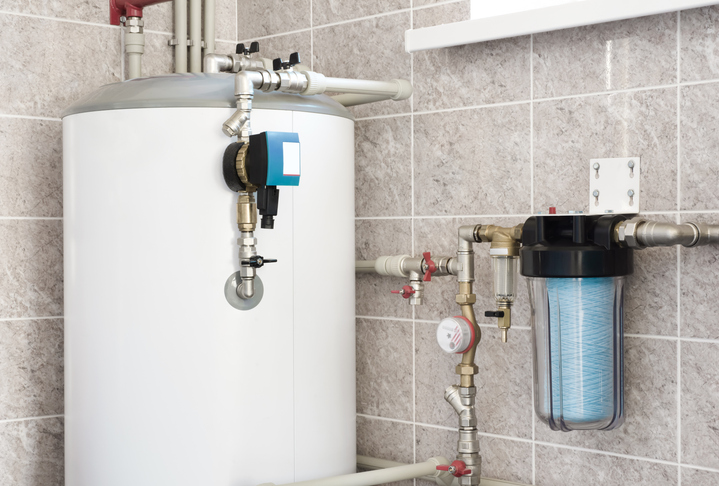
The hot water system holds the largest volume of water in the house, often in a roof space or a cupboard, and it deserves its own walk around before you leave.
Is it safe to leave it running?
Yes, in most cases. A sound storage system simply holds its temperature and cycles as needed. For a very long absence, switching it off at the isolator saves energy and removes the risk of an element or thermostat failing while nobody is home. Leave the tank full either way, and never restore power to a drained cylinder. Heating an element in air destroys it in seconds.
What should you look for before you go?
Look at the base of the tank and around the element or burner for weeping, rust staining or mineral crust. Lift the lever on the temperature and pressure relief valve briefly and let it seat again, then confirm the discharge pipe is clear and terminates somewhere safe rather than somewhere it can pool. Check that the tempering valve at the outlet is not crusted or seized. Tempering valves have a service life of roughly five years, so an ageing one is worth replacing on principle.
What Should You Check Outside and Around the Drains?
Outside is where water does its most expensive damage, because it undermines things rather than staining them. Melbourne’s west sits on reactive clay soils that swell and shrink with moisture, and a downpipe discharging beside a footing for weeks is how brickwork starts to crack.
- Clear the gutters and downpipes. A blocked downpipe sends roof water down the wall and against the slab instead of away from it.
- Check the stormwater grates and pits. Clear leaves and sediment so the system can actually take water away in a downpour.
- Turn off and disconnect garden taps. Disconnect hoses entirely. A hose left connected under full pressure can split.
- Isolate irrigation. A solenoid that sticks open will water the garden until the ground gives way.
- Refill the traps. Every floor waste, shower drain and gully holds a water seal that stops sewer gas entering the house. Over a long hot absence that seal evaporates and you come home to a bathroom that smells like a drain. Pour a couple of litres into each one.
- Deal with slow drains before you leave. A drain already running slowly is a partial blockage, and roots keep growing while you are away.
If any of that looks beyond a quick tidy, deal with it before you go. Nothing on that list improves with a month of neglect.
Frequently Asked Questions
How long can a house sit empty before plumbing problems start?
There is no fixed rule, but risk starts climbing after about a month. Trap seals begin evaporating, water in pipes and tanks sits stagnant and warm, rubber hoses keep ageing under pressure, and there is nobody to catch the first sign of a leak. Longer absences do not create new categories of problem, they simply give the existing ones more time to develop.
Is it better to leave the water meter on or turn it off?
For anything longer than a few weeks, turn it off at the meter. That removes supply pressure from every pipe, hose and valve in the house. The trade off is that irrigation, evaporative cooling and automatic pool top ups stop working, so those need separate arrangements while you are away.
Conclusion
Preparing a house for a long absence is not about expecting the worst. It is about removing the handful of failure points you can control, so the ones you cannot control have far less to work with. Isolate the supply, deal with the hoses and appliances that cause most floods, look honestly at the hot water unit and the roof drainage, and give somebody the key and the meter reading.
If you would rather have the checks done properly before you go, New Image Plumbing & Gas can work through the property with you. We look after homes across Melton and Melbourne’s west, and we can test the isolation valves, check the hot water system and its relief valve, camera the drains if there have been previous problems, and tell you plainly what needs doing before you lock the door. Call 0489 246 667 or submit our online form to book a service.