The kitchen sink is the hardest working drain in the house. It takes everything the bathroom drain never sees: cooking oil, meat fat, coffee grounds, flour, rice, potato peel, eggshell. Most of it goes down without complaint for years, and then one evening the water stops moving and you are standing over a sink full of grey water.
The good news is that a kitchen drain almost never blocks by accident. It blocks because of what has been going into it. This guide covers what actually causes the problem, the habits that prevent it, what you can safely do yourself, and the point where a plumber in Bacchus Marsh needs to be involved.
What Causes a Kitchen Sink to Block?
Kitchen blockages tend to build up rather than happen suddenly. The pipe narrows over months until one extra plate of leftovers is the straw that stops it completely.
Fats, oils and grease
This is the single biggest cause of blocked drains in Bacchus Marsh, and it is the one most households get wrong. Fat and oil are liquid when they are hot, so they flow away freely. By the time they have travelled a few metres down the pipe they have cooled and set, coating the inside wall with a sticky layer. Every food particle that follows sticks to it, and the bore of the pipe slowly closes.
Food scraps that do not break down
Some scraps pass through without trouble. Others either do not break down at all or swell once they are wet. Coffee grounds clump and pack into bends, eggshells fragment into sharp pieces that catch on existing grease, and rice, pasta and flour absorb water and turn into a paste that sets like mortar in a horizontal run.
Soap, detergent and starch residue
Soap scum is not just a bathroom problem. Detergent residue combines with fat and starch to produce a grey sludge that lines the pipe. On its own it is soft, but mixed with grease it forms a hard, waxy layer that water cannot shift.
A waste disposal used as a bin
If you have a disposal unit, it is designed for small, soft scraps, not for bulk food waste. Loading it with vegetable peelings, bread or fibrous material turns the waste into a pulp that coats the pipe downstream. It also does nothing about grease, which is the real problem.
The dishwasher connection
Most dishwashers discharge into the sink waste or the trap beneath it. Grease and food residue from the dishes enters the same pipe that the sink uses. When that branch blocks, the first sign is often the sink backing up when the dishwasher runs.
Older pipe materials and shallow falls
Older homes often still have galvanised or cast iron waste pipes that have scaled up internally over decades, or earthenware lines with open joints. Even where the pipe is sound, a shallow fall means water moves slowly and solids settle out instead of being carried away.
Simple Habits to Prevent Drain Blockages
Prevention is genuinely simple here. A few habits, applied consistently, will keep most kitchen drains clear for years.
Scrape before you rinse
Scrape plates, pans and bowls into the bin or the compost before they go anywhere near the sink. This one step removes most of the solid material that would otherwise become the base of a blockage.
Never pour fat or oil down the sink
Let cooking oil and fat cool in the pan, then wipe it out with a paper towel or pour it into a container and bin it. Small amounts still count. A tablespoon of fat a day adds up to several litres a year sitting in your pipe.
Use a strainer and empty it
A simple mesh strainer in the sink basket catches most food particles before they enter the pipe. It only works if it is emptied into the bin rather than pushed down the drain.
Flush with hot water after washing up
Once the dishes are done, run the hot tap for thirty seconds with a drop of dishwashing liquid. This helps move residual fat through the trap before it sets. Hot water from the tap is enough. Boiling water poured into older or plastic pipes can soften or distort them.
Clean the trap
The P-trap under the sink is where most of the debris collects. Unscrewing the base of it every few months and clearing it out takes a couple of minutes and prevents a large share of slow drains.
How to Clear a Slow Drain Safely
If the water is draining but slowly, these steps are worth trying in order. Stop as soon as the flow returns to normal.
Hot water and dishwashing liquid
Pour a generous squeeze of dishwashing liquid into the drain, then follow with a jug of hot, not boiling, water. This is most effective on light grease build-up and costs nothing.
Baking soda and vinegar
Half a cup of baking soda followed by half a cup of white vinegar will fizz and loosen light residue. Leave it for fifteen to twenty minutes, then flush with hot water. It is safe for your pipes, but it is limited in what it can achieve against a hardened grease plug, so do not expect miracles.
Plunge it properly
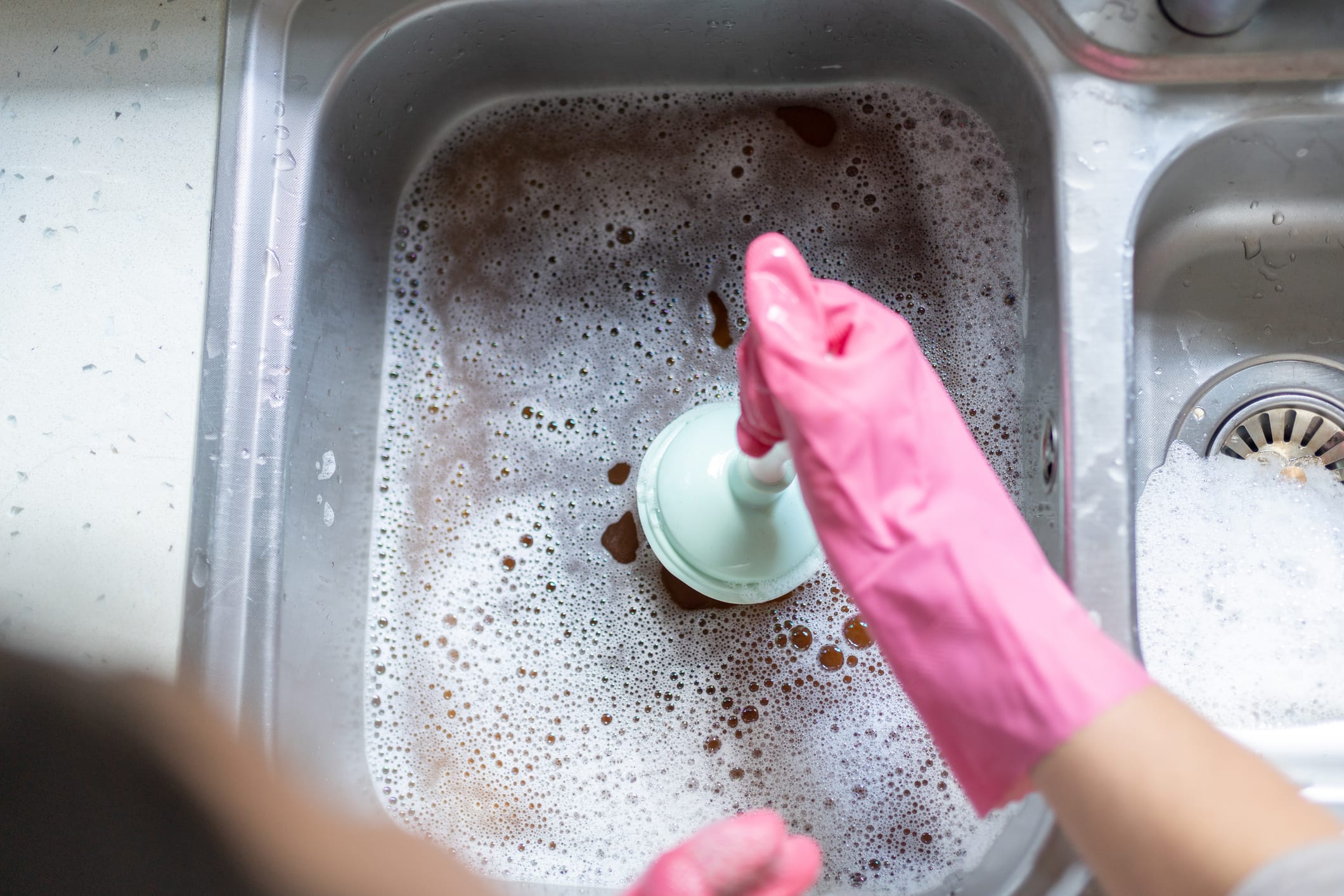
Use a cup plunger rather than a flat one, make sure there is enough water in the sink to cover the rubber, and block the overflow or the second bowl of a double sink with a wet cloth. Then plunge in firm strokes. The seal matters more than the force.
Clean the P-trap
Put a bucket underneath, unscrew the trap fittings by hand, and empty the contents into the bucket. Most sink blockages are sitting right there. Check the trap arm and the waste outlet while you have it apart.
Know when to stop
If the water is not moving at all, if plunging makes other fixtures gurgle, or if the same drain blocks repeatedly, the problem is further down the line than a trap or a plunger can reach. That is the point to stop improvising.
Why Chemical Drain Cleaners Cause More Problems
The bottle promises a fast fix, and it often seems to deliver one. What it does not tell you is what it leaves behind.
- Caustic and acid cleaners attack rubber seals, washers and plastic joints, which is exactly what holds your waste pipes together
- They generate heat as they react, and in older or thin-walled pipe that can cause damage you cannot see
- They thin a blockage rather than removing it, so the drain often slows again within weeks
- They cannot reach a compacted plug deep in the line, clear roots, or fix a collapsed section of pipe
- They leave a corrosive pool sitting in the pipe if the water will not drain, which is the worst case for the plumbing
- They create a genuine chemical hazard for the plumber who has to open the drain later
None of this means a slow drain has to be lived with. It means the answer is mechanical rather than chemical: remove what is sitting in the pipe instead of dissolving part of it, and the result lasts longer than a fortnight.
What Not to Put Down a Kitchen Sink
Some of these are obvious, others surprise people. All of them are common causes of repeat blockages.
- Cooking oil, fat, butter, dripping and pan juices
- Coffee grounds, which clump and pack into bends
- Eggshells, which break into sharp fragments that catch on grease
- Rice, pasta, couscous and flour, which swell and set into a paste
- Potato and vegetable peelings, especially in volume
- Fibrous and stringy waste such as celery, corn husks and onion skins
- Bread, dough and batter
- Large volumes of milk or dairy
- Paper towel, wipes and anything labelled flushable
- Paint, plaster, grout or cement washout, which sets hard in the pipe
The list is long, but the principle is short: if it is fat, if it swells, or if it will not break down, it belongs in the bin.
When to Call a Plumber
Some blockages need equipment that no household has. These are the signs it is time to book someone:
- The drain has blocked more than once in the same place within a few months
- Water backs up in another fixture, such as the laundry, shower or floor waste
- The sink drains slowly even after the trap has been cleaned
- There is a gurgling sound from other drains when the sink empties
- A sewage smell is coming from the sink or nearby floor waste
- You have already used a chemical cleaner and the drain is still blocked
- Water is pooling around a floor waste or in the yard
A licensed plumber will use a drain camera to see what is actually in the pipe before clearing it, then high pressure jetting to scour the walls clean rather than just punching a hole through the middle of the blockage. That is the difference between a drain that lasts a week and one that lasts a few years.
Frequently Asked Questions
Does boiling water clear a blocked kitchen sink?
It can help with a light grease film, but it is not a cure and it carries a risk. Water at full boil poured into a PVC waste pipe or an older joint can soften or distort the plastic. Use hot water from the tap rather than a kettle, and if the drain is fully blocked, hot water will simply sit on top of the blockage and cool down.
Is baking soda and vinegar actually effective?
It is safe and it does loosen light residue, but its reputation is overstated. The fizzing is a reaction that produces gas, not a solvent that dissolves fat. Against a hardened grease plug, the most it will do is soften the edges. It is a reasonable maintenance step, not a rescue remedy.
Why does my kitchen sink smell even though it drains fine?
A smell with good flow usually points to biofilm and food residue coating the inside of the trap and the tail pipe, or to a failing seal at the waste connection. It can also come from a build-up in the overflow or the dishwasher hose. Cleaning the trap and the tail pipe generally sorts it out.
How often should kitchen drains be professionally cleaned?
There is no fixed rule, and a household that keeps grease out of the sink may never need it. If you cook with a lot of oil, if the property has older pipework, or if the drain has blocked before, an annual jet and camera check is cheap insurance against a failure in the middle of winter.
Conclusion
A kitchen sink drain does not fail because of one bad night. It fails because a little bit of fat, a few coffee grounds and a handful of rice go down every week for years, and the pipe gets a little narrower each time. By the point the water stops moving, the blockage has usually been building since well before anyone noticed.
That is also the reason the simple habits matter more than the clever remedies. Scraping plates, binning the fat and running hot water at the end of the wash are unglamorous, but they address the cause rather than the symptom. When a blockage does happen, cleaning the trap and plunging correctly will clear most of them, and knowing when to stop is what prevents a small problem from becoming a damaged pipe.
If your kitchen sink is draining slowly, backing up when the dishwasher runs, or blocking for the second or third time in the same spot, New Image Plumbing & Gas can find out why. Call 0489 246 667 and get it cleared before it backs up at the worst possible moment.